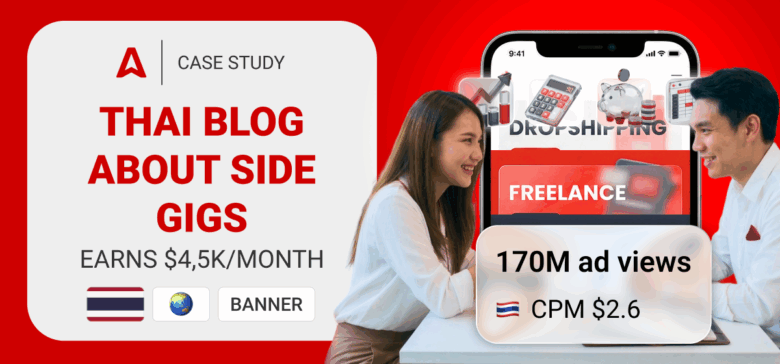
Chaiya’s business portal is focused on personal finance, Thailand side hustle ideas, and productivity optimization for Thai audiences. He lays out how to build a side-hustle website in Thailand and increase both traffic and revenue without magic or clickbait figures. His Popunder-only approach differs from Sara’s, a food blogger who mixes five income streams, but demonstrates huge potential for publishers starting out on a side gig.
Disclaimer:
The story was translated by the Adsterra Content team. We had to depersonalize web screenshots and remove sensitive data to protect the publisher’s privacy. We tried to keep the copy authentic, but we may have misinterpreted local naming or slang. Please be tolerant of this 😉
I’m Chaiya. I’m 32, and I work as a full-time content strategist at a medium-sized marketing agency from Monday to Friday. What I’m about to share with you happened outside of the 9-to-5 on weekday evenings, Saturdays, and during certain holidays when I took longer Songkran breaks.
Although I had the knowledge of personal finance and the concept of side-hustles, in 2023, I was a desk job worker living off a salary. To keep myself accountable, I began to journal about what I learned to apply. I first wrote about negotiating my lease, then published my attempts to get additional income. Such publications formed my Thai-language blog. These genuine, detailed entries clicked with Thai readers. That was three years ago. So what’s for today?
How to earn money in Thailand: My revenue breakdown
Today, the site earns approximately $4,500/month from 300×250 sidebar banner placements (see the revenue proofs below). The average CPM for Thailand stays solid, abou $2.6 per 1,000 impressions. I am about to add Popunder, and I will explain my reasons for this later.
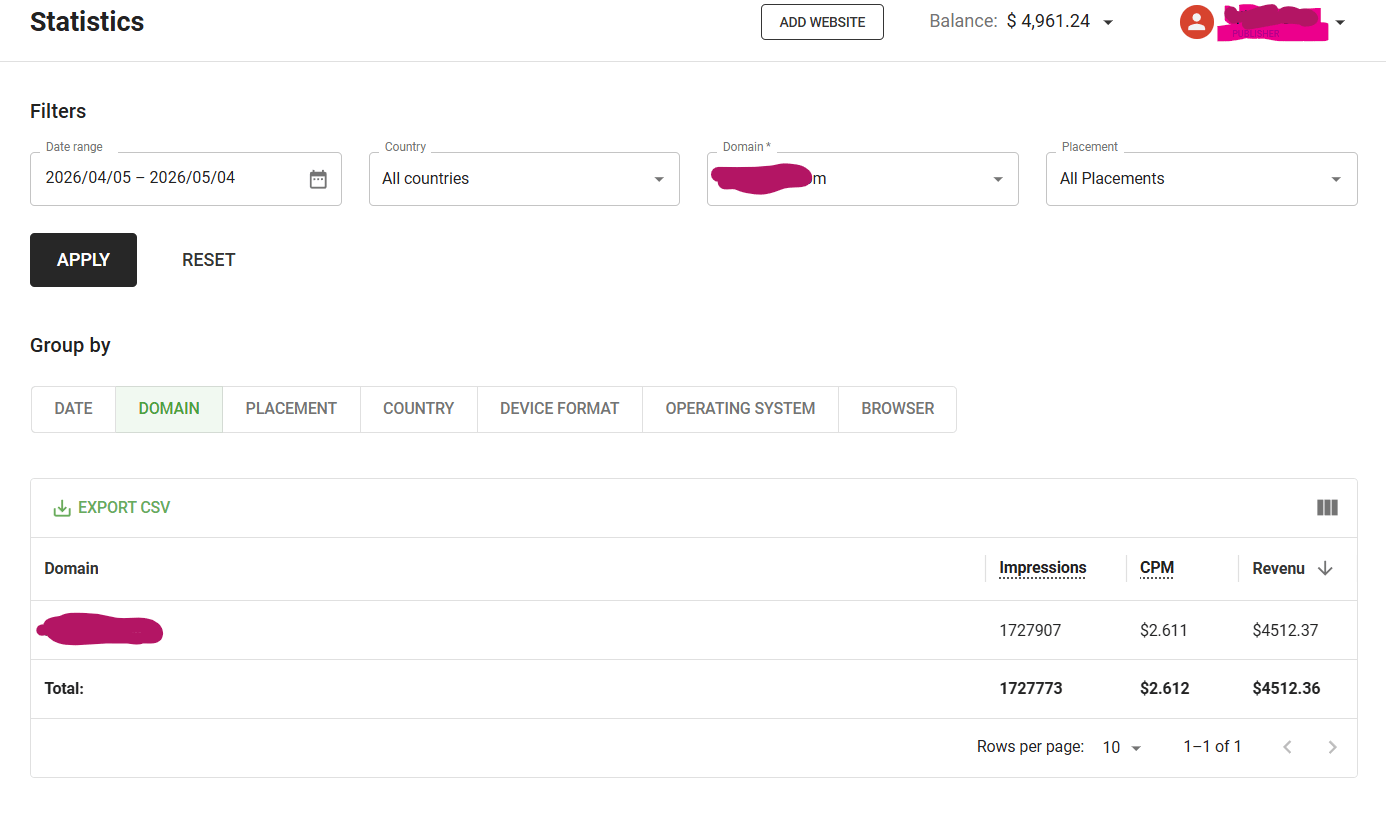
I’ll give you the honest picture of how I built the traffic — and how long it actually took.
How I built a side-hustle website in Thailand to earn online
If you have read some Thai publisher guides that promise 1.3 million monthly impressions 6 months after launch, treat those with skepticism in 2026.
Thai SEO for finance/business content is hard. Signals for finance are very inflexible on Google. EEAT (Experience, Expertise, Authoritativeness, Trustworthiness) is not a switch to flip but the result of editorial effort over time. I do not create YMYL content, but the “Google sandbox” issue still occurs. A new domain with no backlinks and no established crawl authority typically will rank for no relevant queries in the first 3-4 months, even with great content.
Thai internet users who search for personal finance, time management, or side hustles are intelligent enough to close out immediately if it feels thin or AI-written.
Here are my real 4-month results:
| Period | Monthly sessions | Monthly Revenue | Notes |
| Months 1–4 | 80 – 4,500 | $0 | No monetization; building content, a few indexed pages; direct traffic from friends |
Now, the hard truth. It took me thirty-one months from zero to $4,500/month. Not eighteen, not twelve, but thirty-one! I was about to give up between months eight and fourteen, the period when traffic is meaningful but not yet large enough to generate significant income. That period is where most people quit. It is also exactly when the SEO compounding is beginning to work and where quitting is most costly.
What the finance & lifestyle website should cover
If you want to make a powerful side-hustle website in Thailand, you should center on content pillars, audience interests, and potential revenues.
Pillar 1: Personal finance for Thai millennials and Gen Z
These articles built my foundation. Some of the topics covered:
- How to open a savings account in Thailand that earns more than 0.5% interest.
- Which Thai mutual fund platforms have the lowest entry requirements?
- How to read a Thai payslip and understand what’s being deducted
- What a provident fund is and whether to contribute more than the minimum.
I wrote these in Thai, for Thai readers, using relevant examples with baht figures and local financial institutions by name.
This local specificity is why these articles rank. A generic article about “how to start investing” would get lost in the Thai search. An article titled “Opening a mutual fund account: SCB vs K-My Funds: What’s the difference?” will rank for a specific Thai-language query that has search volume and near-zero quality competition.
The keyword strategy I use across the entire site: hyper-specific Thai-language queries that English-language finance content cannot rank for and that Thai financial institutions themselves don’t produce consumer-friendly explanations for.
Pillar 2: Thaikand side hustle ideas and online income guides
This is my highest-traffic pillar and my most important driver of CPM. Articles of this cluster cover:
- Freelance income in Thailand
- Dropshipping with Thai suppliers
- Digital product sales for creators
- Freelancer registration for legal tax purposes in Thailand
- Thailand’s rules for receiving international payments
Articles and guides attract readers who are actively interested in earning more money. They have a high-commercial-intent demographic that advertisers in the financial services and digital tools categories value strongly.
I also cover cryptocurrency education, but only from the perspective of what blockchain technology is, how Thai tax law treats crypto gains (the Revenue Department issued guidance on this; I covered it in depth), and how to read a crypto whitepaper.
Educational framing of financial topics keeps the content fully compliant with Thai financial content regulations while still attracting the higher-CPM advertiser demand.
Pillar 3: Lifestyle and productivity optimization for Bangkok workers
I’m highly selective about this broadest pillar. The focus is only on business-related topics like:
- Reducing Bangkok commuting costs (BTS vs. car)
- Hidden renting vs. buying costs
- Salary negotiation in Thai culture
- Evaluating benefits packages.
This lifestyle content attracts readers earlier in their financial journey, who then convert well to deeper finance content via internal links.
I avoid non-financial lifestyle content (wellness, relationships, entertainment). It would broaden my audience but dilute my finance EEAT signals and attract lower-CPM traffic. The site must remain focused.
Traffic sources: The real mix
Here’s my traffic breakdown (4 sources) and what percentage each contributes. This will explain a lot about my revenue and also my CPM.
Google Search (67% of sessions)
Any inventory, including a side-hustle website in Thailand, must prioritize the Thai language. Organic search is my primary traffic source and the most commercially valuable.
My Thai readers, finding my content through search terms like “mutual funds,” “side hustles Thailand 2026 ,” and “tax questions,” are in the midst of their financial decisions and are avid readers and watchers of relevant ads (for example, fintech, digital wallets, etc.).
My top-performing content by session volume is the side-income guides, specifically articles about how to make money online in Thailand that are up-to-date (I update them quarterly) and hyper-specific to the Thai landscape.
LINE official account (18% of sessions)
From a messaging app in Thailand, LINE has grown into an ecosystem with a communication infrastructure. Publishers can broadcast content to subscribers who have voluntarily followed their account through the LINE Official Account system. My account now has 41,000 followers. When I publish a new guide, I share a preview with them. The click-through rate from my broadcasts is approximately 6.8%, which is significantly higher than that of email newsletters in general.
Building a LINE following took significant effort: I promoted my account in Thai finance Facebook groups, in the LINE groups for graduates of my university’s economics faculty, and through a “free monthly personal finance check-up template” offer that I’ve maintained for two years. The template is a genuine Google Sheets budget tracker I built specifically for Thai wage structures. It has been downloaded 28,000 times.
Facebook Groups (9% of sessions)
I’m an active member of four groups relating to finance and side hustles, where I share links to my articles only if they are topical and fit the discussion well. No spam, no “check my post”: I contribute to the conversation and add value; I link my guides for anyone asking directly for more info.
Direct and returned traffic (6% of sessions)
A growing segment of my audience returns directly, typing in my blog’s URL. Articles made as tools and calculators are the most bookmarked pages on my site. One such tool is the Thai Tax Calculator, which calculates personal income tax under Thailand’s 2024 progressive tax structure.
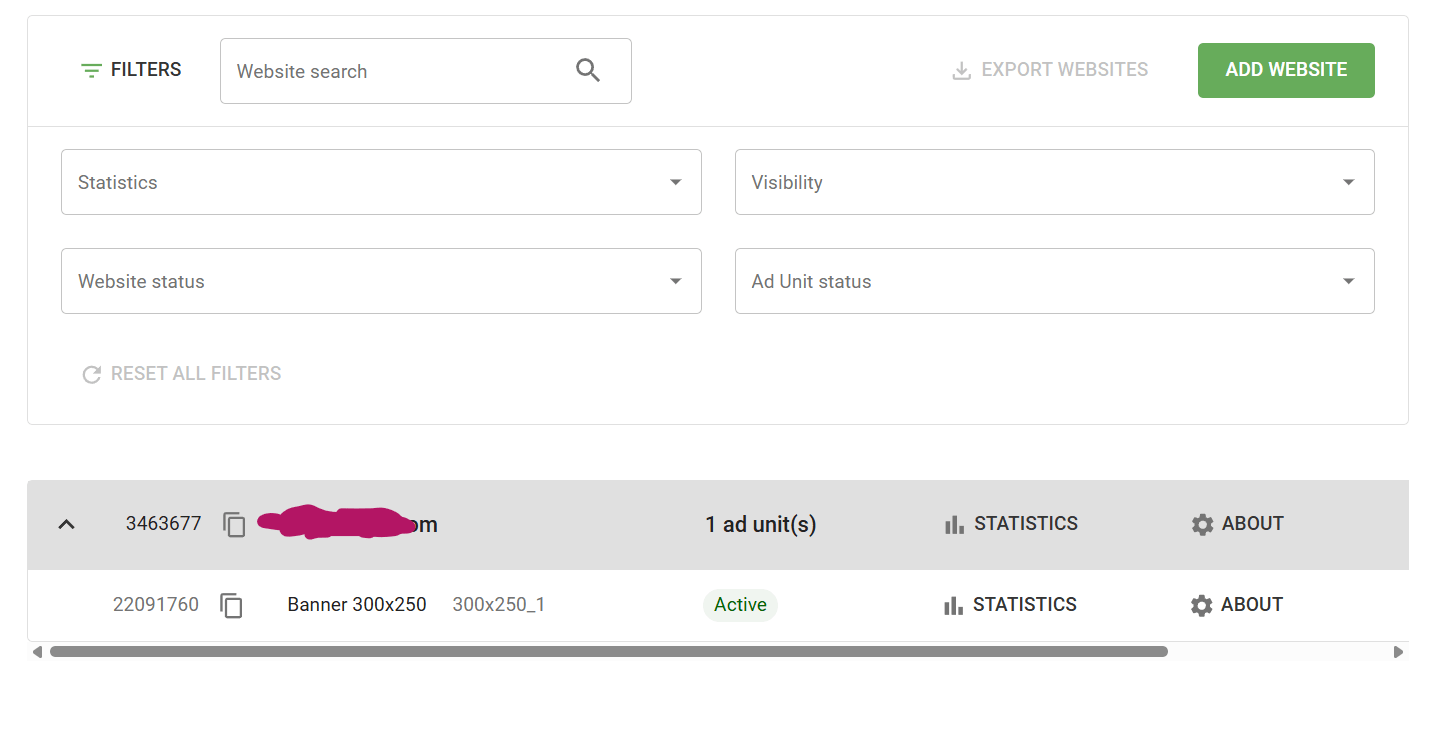
The earning model: 300×250 sidebar banner + Thai traffic
The 300×250 medium rectangle is the most-served banner size on the internet. I thought that on a finance blog where readers spend 4–6 minutes per article, the sidebar placement viewability scores would be high. And I was right!
How much my side-hustle website makes from Thai traffic
The table below tells a story that is important to read carefully. Thailand holds 97.3% of my impressions and 97.2% of my blog revenue. My audience is almost entirely domestic Thai.
Actually, I was hoping to diversify traffic with Malaysian, Singaporean, and diaspora US/AU segments. But the idea has not materialized at a meaningful scale because my content is fully adapted to Thai readers.
The US, Australian, and other Tier 1 rows generate impressive CPMs ($9.371 for US, $6.357 for AU), but their impression volumes are too small to become noticeable revenue contributors.
| Country | Impressions | Clicks | CTR | CPM | Revenue |
| Thailand | 1,681,961 | 276 | 0.016% | $2.609 | $4,387.45 |
| United States | 6,037 | 0 | 0% | $9.371 | $56.57 |
| Australia | 3,174 | 2 | 0.063% | $6.357 | $20.18 |
| Japan | 4,505 | 0 | 0% | $2.862 | $12.89 |
| United Kingdom | 2,177 | 0 | 0% | $2.484 | $5.41 |
| Singapore | 3,259 | 1 | 0.031% | $1.382 | $4.51 |
| Hong Kong | 2,079 | 0 | 0% | $1.540 | $3.20 |
| Malaysia | 1,339 | 0 | 0% | $2.133 | $2.86 |
| Canada | 746 | 0 | 0% | $3.311 | $2.47 |
| Germany | 2,058 | 0 | 0% | $1.177 | $2.42 |
| Total | 1,727,773 | 279 | 0.016% | $2.612 | $4,512.36 |
What $2.609 Thai CPM means in practice:
A $2.609 CPM from Thai traffic would be a reasonable and attainable benchmark for a finance-content publisher of my size; more than the $0.20 floor discussed on forums and less than the $5+ ceiling only achievable through Tier 1 focus.
The 300×250 format, finance content category, and strong viewability from an engaged finance readership combine to deliver my high CPM rates consistently.
The Thai SEO strategy that actually worked
You know my content approach, now I will give more facts about workable SEO techniques (and one failure I don’t regret).
Researching Thai keywords only
I research how Thai users actually search, using Google Search Console data from my own site, Google Autocomplete in Thai, and Ahrefs’ Thai-language keyword database.
A Thai person searching for investment guidance does not search “how to invest in Thailand” in English; they type in “investment methods for salaried workers” in Thai. Here, intuition comes along with research.
Content clusters aligned with working people’s life stages:
My site is designed around Thai financial decisions.
1. Beginning of career: (First three months in a job) – understanding payslips and provident funds.
2. Life stability, stable earnings: (Emergency funds, first investments, insurance)
3. Wealth building: (Portfolio diversification, legitimizing side hustles, maximizing tax deductions).
Within each cluster, I build the cross-link strategy to power my money-driving pages.
Content refresh (regular, significant updates)
Every few months, Thai regulations shift: tax numbers adjust, bank options evolve. That is why I rebuild key money-related posts each quarter rather than leave them untouched. Search engines favor pages that show real changes over time. Since starting these updates, visits climbed sharply, often rising by two to four out of ten readers within a month and a half.
Building the LINE audience
It just happened that my LINE account got noticed. Earlier, when I wasn’t running anything on the side, I jumped into Thai money-related LINE groups and started talking in their chats. What did folks really care about? That’s what I had to learn, for work tied to client promotions. For half a year, I gave thoughts without pushing anything of mine. Only later did I post links to things I wrote. People welcomed it then, since they’d already seen me add value, never push.
Failing on Kapook and Sanook
Regarding guest posting on Kapook and Sanook: I have not published content on either. I have tried to contact both. Kapook’s editorial team did not respond, and Sanook requires a commercial content partnership. Any expert who suggests placing unrequested guest posts on these platforms as an organic link-building strategy has not actually attempted it.
I have built my backlink profile through a combination of smaller Thai finance blogs where cross-publishing relationships are feasible and natural links from Thai university student finance communities.
Timely mobile optimization
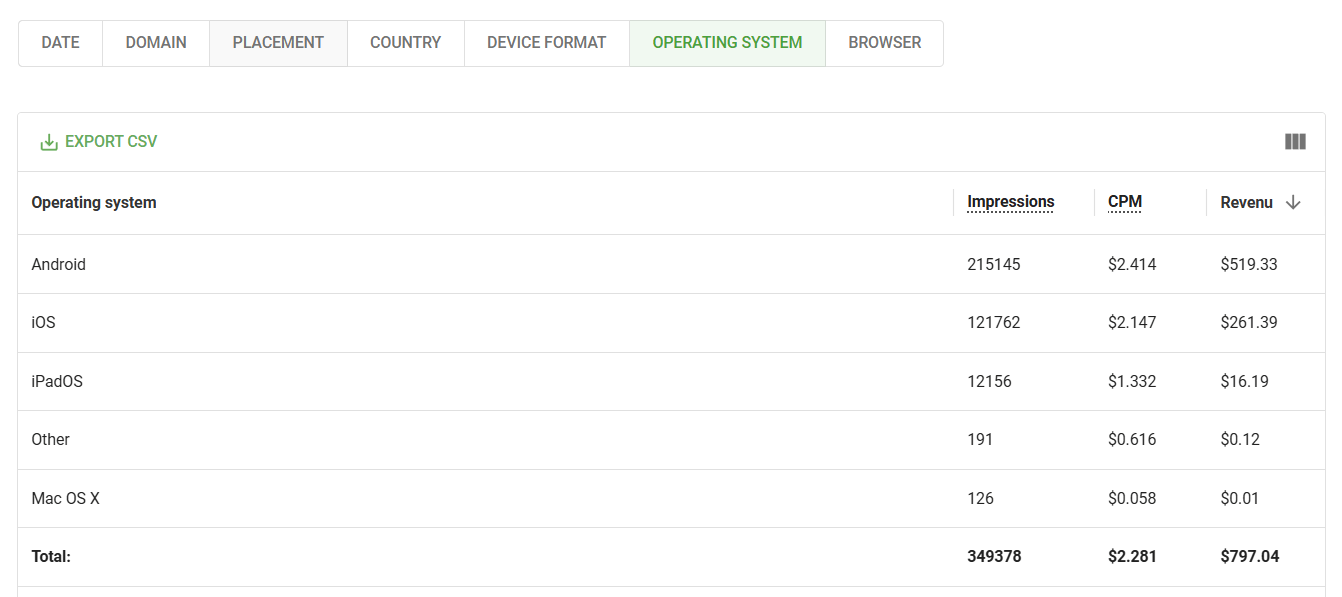
81% of my traffic is mobile. A finance article with tables that don’t render correctly on mobile, or with a load time above 2.5 seconds on a 4G connection, loses readers before they see ads. Test every new article template on a mid-range Android device, specifically a Samsung Galaxy A series phone, which is a popular device category among Thai internet users before publishing.
That’s a 5-day breakdown by my visitors’ OS:
Closing: How to earn money online in Thailand
I started this blog to hold myself accountable for my own financial behavior. Three years later, I earn $4,500/month as a creator in Thailand, my homeland. This amount took careful content investment, community building, and patience to reach, but now I can see clearly how to grow from here.
The Popunder test is my next step. My Adsterra manager has been helpful in walking me through the configuration specifics, and we decided to test it on several high-traffic pages. My conservative forecast: the Popunder addition should bring me comfortably past $5,700–6000/month without any changes to my traffic or content strategy.